

How To Change Mercedes-Benz Brake Pads
If you own a Mercedes-Benz, you know that, although it’s built to last, certain things need maintenance on a regular or semi-regular basis. Your brakes are no exception. Changing out brake pads on an automobile may not be something you’re comfortable with. Not everyone has the tools or know-how – or even a good location – with which to do a job like this. Your best bet, in that case, is to schedule an appointment for maintenance with your Mercedes-Benz service center.
If, on the other hand, you are well-versed in car repairs and maintenance, you have the right tools, and you have access to a place in which you can work on your car, you may want to attempt the job yourself. Here, we are going to offer a simplified guide to changing out the brake pads on your Mercedes. We will also briefly touch upon changing out rotors.
Keep in mind that not all automobiles are exactly alike, so the steps you take/tools you need to change out brake pads may differ slightly from vehicle to vehicle.
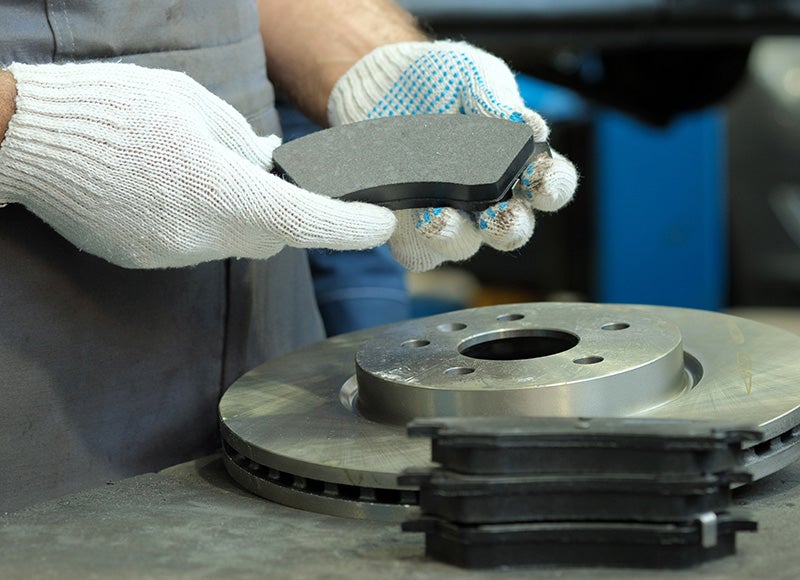
You’ll Need the Following Materials
- Needle nose pliers
- Disc brake pad grease
- Brake cleaner and micrometer/digital caliper are optional
- Flat head screwdriver
- Caliber hanger
- Jack stands and floor jack
- Brake caliper piston compression tool
- Appropriate Torx sockets (possibly T 25 and T 45)
- Long handled ratcheting wrench
- The appropriate sockets (possibly 8 mm, 13 mm, and 18 mm)
- Appropriate thin profile wrench (possibly 17 mm)
- Rubber mallet
- Appropriate brake rotors (if you are also replacing the rotors) and brake pads
Steps For Changing Out Brake Pads (And Possibly Rotors)
- On jack stands, you will lift and support the vehicle. The wheels can be removed once the vehicle is supported.
- To allow more rotor clearance, turn the steering wheel.
- While turning the two 13 mm bolts counterclockwise, hold the 17 mm bolt in place with the thin profile wrench.
- At the connector, pull apart/disconnect the brake wear sensor on the passenger side.
- The caliper will come off when you pull up and away from the rotor. To make sure the rubber brake line doesn’t get damaged, use a caliper hanger.
- Slide the front brake pads from the rotor and free them away from the caliper bracket.
- With your screwdriver, pry the metal clips off the caliper bracket.
- Squeeze the piston back into the caliper using an appropriate brake caliper compression tool (the piston should not be compressed all the way in).
- Take off the two 18 mm bolts to remove the brake caliper brackets.
- From the rotor, remove the Torx bolt (possibly T 27)
- At this point, the rotor should be freely removable. To remove the hub, wiggle it towards you.
- The process you just used for removal of brake pads and rotors will now be reversed to install the new brake pads and rotors.
- Avoiding any rubber, brake cleaner can be sprayed on the caliper and rotor to clean them.
- On brake pad contact areas, apply disc brake pad grease.
- Some brakes are marked with an arrow because they are directional. In the direction of wheel rotation, install the arrows (unless otherwise directed).
If you’d like some assistance with the above-stated steps, there are online videos you may find helpful. Remember, if you’re unsure, don’t have the right tools, don’t have the space in which to work on your car, and/or don’t have the know-how, contact a Mercedes-Benz service center instead.
Do You Need Your Brake Pads Replaced? Count On Mercedes-Benz of Smithtown
Are you in need of brake pad replacement? Perhaps you’re unsure of precisely what your braking system needs. Either way, feel free to speak with a representative of Mercedes-Benz of Smithtown.
Click “schedule your service” here if you’d like to set up an appointment for brake pads or any other type of work on your vehicle. You can also phone us at 877-498-5967. If you need more information or have further questions, please feel free to contact us.